
I can still remember my first Back-to-School Night at a new school, after five years at a previous school.
I was teaching a new grade, and because I was new to the team, I had done what seemed perfectly logical: I used the same slide deck as the other teachers on my grade level.
All 27-ish slides of it.
There were curriculum overviews. Homework expectations. Classroom procedures. Grading information. Schedules. Policies. Probably several things I have completely blocked from my memory.
And I was determined to cover ALL OF IT.
So I talked.
And talked.
And talked.
At one point, I stopped to take a breath and realized two things: First, I had been speaking at a speed normally reserved for auctioneers. Second, based on the amount of oxygen I inhaled, I appeared to have delivered the previous five minutes on one continuous breath.
I wanted families to have everything they needed.
What I missed was that more information wasn’t what they needed most. While I was worried about getting through slide 19 before the clock ran out, the adults sitting in front of me had a much shorter list of questions.
Do you like my child?
Will you help my child grow?
Will you expect enough from my child while supporting them along the way?
That’s it.
Of course, families need information about curriculum, communication, homework, grading, and all of the other logistics that come with a school year, and they don’t need you to fit an entire year’s worth of information into one 30-minute presentation!
Instead, think about what you say during Back-to-School Night as an opportunity to help families hear the answers to those three bigger questions.
Do You Like My Child?
You don’t have to stand at the front of the room and announce, “I LIKE YOUR CHILDREN!”
In fact, please don’t do that!
What families are really listening for is evidence that you know these kids, enjoy being with them, and are genuinely glad they’re yours this year.
And specificity makes this incredibly powerful.
You might say, “We’ve only been together a few weeks, but I’m already seeing how much this group looks out for each other. The other day during a math game, one student couldn’t find the materials they needed, and before I could even get across the room, two other students had jumped in to help.”
Or, “One of the things I’m already loving about this group is how curious they are. We started talking about ecosystems last week, and a question about what would happen if one species disappeared turned into this incredible conversation that I hadn’t even planned for.”
These aren’t dramatic stories. That’s the point.
They’re little moments from everyday classroom life that tell families, I notice your kids. I enjoy them. Good things are happening here.
Before Back-to-School Night, think of one or two specific moments that have made you smile, laugh, or feel proud of your class.
Then tell those stories.
Will You Help My Child Grow?
Families know their children won’t walk into your classroom already knowing everything you’re going to teach.
What they want to know is what happens when their child doesn’t know.
Will you notice?
Will you help?
Will there be room to make mistakes, ask questions, practice, and try again?
You don’t need to explain every intervention available in your school or pull up the entire MTSS flowchart. Just help families understand what learning looks like with you.
You might say, “Kids aren’t going to understand everything the first time, and I don’t expect them to. We’re going to practice, I’ll give them feedback, and we’ll keep working. I want students to learn that not knowing something yet is part of learning.”
You can also help families see that growth in your classroom goes beyond academics, “Part of my job is helping students grow as learners-not just in math, but in things like asking for help, working independently, collaborating with others, and learning what to do when something feels hard.”
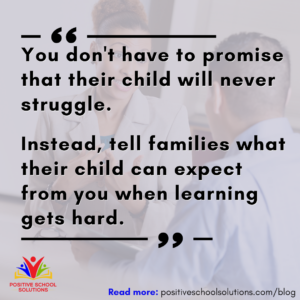
You don’t have to promise that their child will never struggle.
Instead, tell families what their child can expect from you when learning gets hard.
That’s far more reassuring.
Will You Expect Enough From My Child?
This is where high expectations and strong support come together.
Families want to know that you see what their child is capable of. They also want to know you’re going to help them get there.
Again, you don’t need to read every classroom rule aloud or explain every possible consequence.
Help families hear your belief in their children.
You might say, “I’m going to ask a lot of your kids this year because I know they’re capable of a lot. And when I introduce a new expectation, we’re going to talk about it, practice it, and make sure students know what success looks like.”
Or, “Mistakes are going to happen this year-in our work, with our organization, and with each other. I’ll hold students accountable, but I’ll also help them figure out what to do differently next time. That’s part of learning, too.”
The message you want families to hear has two equally important halves:
I believe your child is capable. And I will help them get there.
But What About Everything Else?
Yes, families still need to know about homework.
And grading. And communication. And schedules. And whatever app requires the 47-character access code they will inevitably need again in November.
Share those things.
But you don’t necessarily have to spend your limited time explaining every one of them.
If families can read it later, give them an easy place to find it later.
You might simply say, “You’ll find our homework and grading information here. I won’t spend our limited time reading through all of it tonight, but I want to make sure you know where to find it-and I’m always happy to answer questions.”
Then move on to the things they can’t get from a handout, website, or slide deck.
They came to hear from you.
Before You Add One More Slide…
Families probably won’t remember exactly which month you begin fractions.
Whether you share it or not, they’ll ask you again about what percentage of the grade comes from quizzes.
And despite the amount of time you spent making sure everything was perfectly aligned, they almost certainly won’t remember slide 17.
But they will leave with a feeling about the person who is spending every day with their child.
So before you add one more thing to your Back-to-School Night presentation, ask yourself whether families will leave having heard these three messages:
I like your child.
I will help your child grow.
I believe your child is capable of great things.
If the answer is yes?
Your presentation might be much more ready than you think.
And you can probably delete a few of those slides.
Keep Building Strong Family Connections
Want to go beyond Back-to-School Night? Our Nurturing Positive Family Connections on-demand course is filled with practical ways to build strong, lasting partnerships with families throughout the school year. Learn how to create welcoming experiences, strengthen communication, and build the school-home connections that support student success.
Explore Nurturing Positive Family Connections
Written by Sarah FIllion 2026